



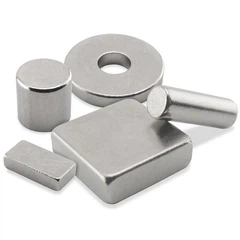
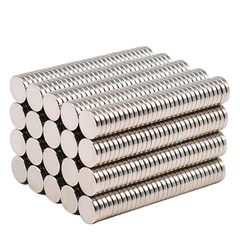

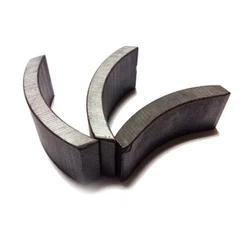


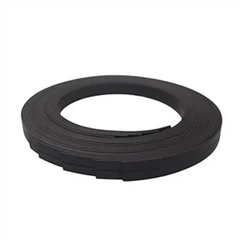







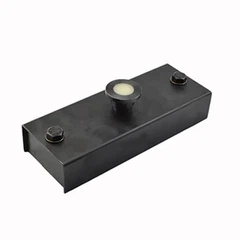
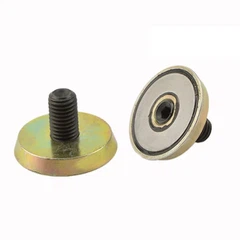
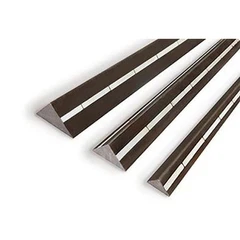
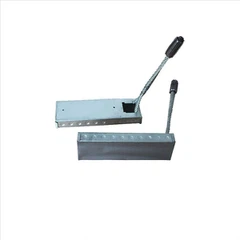


The main shapes of sintered NdFeB magnet products include square slices, cylinders, rings, tile-shaped, sector-shaped, and various special-shaped products. In actual production, large blanks are mostly produced first and then obtained through post-processing according to the user's size requirements. The final product.
1. Slicing (cutting) process

Slicing machine: Use a high-speed rotating thin inner circular diamond cutter to automatically cut NdFeB magnets. Cutting oil is used as cutting coolant during the slicing process. The advantage is that there is no need to customize special tools, it is highly flexible, and it is suitable for sample processing and cutting processing. However, due to low processing efficiency and yield rate, as well as weak ability to ensure verticality, batch slicing production has been gradually replaced by multi-wire cutting machines (wire saws).
Multi-wire saw cutting: Use a tooling fixture to fix the workpiece on the workbench. Through the roller cloth diamond wire, the high-speed running diamond wire (wire diameter 0.2mm) rubs against the magnetic steel to achieve material cutting. The cutting process is cooled by cutting fluid. The main features are that it can cut multiple workpieces at the same time, has high production efficiency, yield rate, and yield rate, has a strong ability to ensure verticality, and is suitable for batch continuous processing. However, special rollers need to be customized for products of different specifications.
Wire EDM: Use molybdenum wire electrodes to generate high-frequency sparks on NdFeB magnets, causing them to melt locally. Controlled by a computer, the electrode wires are cut according to a predetermined trajectory. The advantage of wire EDM is that it has high processing accuracy and can be used for slicing tile-shaped and special-shaped products and cutting large magnets. The disadvantage is that the cutting speed is slow and the melted zone on the cutting surface has a greater impact on the magnetic properties.
Laser cutting: The laser beam is used to focus on the magnetic material. The magnetic material melts and vaporizes, and the disappearing area forms a slit. Laser cutting is non-contact processing, has the characteristics of a small impact on the environment, high processing accuracy, can process inclined surfaces, etc., and has broad application prospects. However, changes in temperature and stress during processing have a certain impact on the performance of the magnet, and when cutting thicker products, the divergence of the laser beam causes a slope in the cutting section.
2. Grinding process
Mainly refers to the processing method of grinding the surface of the workpiece with a grinding disc or grinding wheel. Commonly used grinding methods for square NdFeB magnets include vertical grinding, flat grinding, double-end grinding, etc. Cylindrical and circular NdFeB blanks often use centerless grinding, square grinding, internal and external circular grinding, etc. Tile-shaped, sector-shaped, and special-shaped magnets can be processed using multi-station forming grinders.
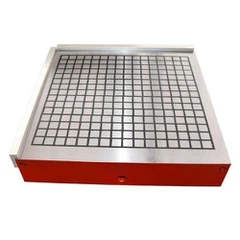
Surface grinder: used for surface grinding of magnetic materials, and can also be used for multi-sided processing. Generally, a horizontal-axis rectangular table surface grinder (flat grinding) or a vertical-axis cylindrical table surface grinder ("vertical grinding") is used. The flat surface of the magnetic steel is neatly stacked as the reference surface and fixed on the disk workbench with a baffle clamp, etc., and a grinding wheel is used. Reciprocating surface grinding.

Double-end grinder: The conveyor belt continuously passes through the product. The two grinding wheels are located on both sides of the product. The horizontal axis double grinding head is used to rotate and drive the grinding wheel (the two grinding wheels produce an inclination angle), and the two planes of the product are ground under the rotation of the grinding wheel. The double-end grinder has high processing precision and small surface roughness. It is the most widely used symmetrical plane processing equipment in NdFeB machining.
Forming grinder: It can grind various flat surfaces, curved surfaces, or grind complex formed surfaces through special grinding wheels (grinding wheel modification). It is suitable for grinding processes that do not require motorized feed to meet the shape requirements of different types of products. Usually used for mechanical chamfering of products or processing of special-shaped products.
3. Drilling (punching) processing

Hole drilling machine (drilling machine): A device that uses diamond ring cutters, the product is fixed by the chuck and rotated by the spindle, and the cutter feeds to process the inner hole of the product. Hole lathes are usually used to process NdFeB products with inner holes above 8mm. Holes can be drilled and reamed using special cutters and reamers.
Instrument lathe: The instrument lathe clamps the magnetic steel product through the clamp, drives the product to rotate continuously through the spindle motor, and uses a fixed alloy tool to drill the rotating workpiece. It is mainly used for drilling and drilling holes in cylinders, rings, and small square products. The processing hole diameter is less than 5mm.
Benchtop drilling machine: A device that uses self-made tooling positioning products and carbide cutting tools to rotate and feed to drill the product; the main difference from the instrument lathe is that the workpiece of the instrument lathe rotates and the tool is fixed; while the workpiece of the benchtop drilling machine is fixed and the workpiece is fixed. The tool rotates. Therefore, the desktop drilling machine can be used to process through holes, blind holes, and step holes in special-shaped products.
Ultrasonic drilling machine: The ultrasonic energy is concentrated in the position of the drill bit through the transducer. The high-frequency mechanical vibration of the drill bit drives the abrasive suspension to achieve impact perforation through high-speed impact, friction, and cavitation. Ultrasonic drilling has high accuracy, efficiency, and qualification rate, and can be applied to small-hole processing of magnetic steel.
4. Chamfer

Manufacturers will choose the most cost-effective processing route based on product size specifications and geometric tolerance requirements. For the quality of processed products, we should mainly focus on dimensional tolerances, geometric tolerances, and appearance. Common defects and defects in processing include out-of-tolerance dimensions, poor verticality and contours, missing corners, cutter wires, scratches, grinding marks, corrosion, cracks, etc.